It is believed that strategic decision making is the responsibility of top management. However, it is considered useful to distinguish between the levels of operation of the strategy.

Strategy operates at different levels of organization viz-Ã -viz:
- Corporate level
- Business level
- Functional level
There are basically two categories of companies; one, which have different businesses organized as different directions or product groups known as profit centers or strategic business units (SBUs) and other, which consists of companies which are single product companies. Eg. Reliance Industries and Ashok Leyland Limited.
The SBU concept was introduced by General Electric Company (GE) of USA to manage product business. The fundamental concept in the SBU is the identification of discrete independent product/market segments served by the organization. Because of the different environments served by each product, a SBU is created for each independent product/segment. Each and every SBU is different from another SBU due to the distinct business areas (DBAs) it is serving.
Each SBU has a clearly defined product/market segment and strategy. It develops its strategy according to its own capabilities and needs with overall organizations capabilities and needs. Each SBU allocates resources according to its individual requirements for the achievement of organizational objectives. As against the multi product organizations, the single product organizations have single strategic business unit. In these organizations, corporate level strategy serves the whole business. The strategy is implanted at the next lower level by functional strategies. In multiple product company, a strategy is formulated for each SBU (known as business level strategy) and such strategies lie between corporate and functional level strategies.
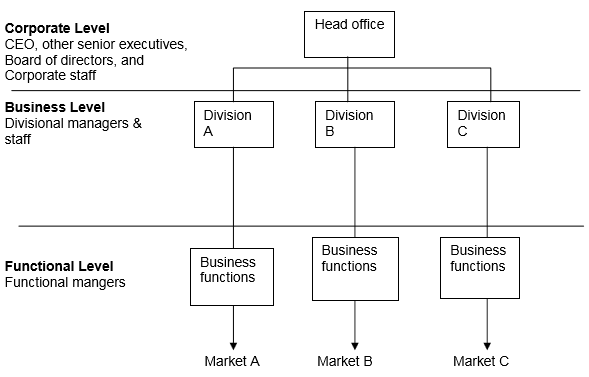
The three levels of strategy in an organization are explained as follows;
1. Corporate level strategy
At the corporate level, strategies are formulated according to organization wise policies. These are value oriented, conceptual and less concrete than decisions at the other two levels. These are characterized by greater risk, cost and profit potential as well as flexibility. Mostly, corporate level strategies are futuristic, innovative and pervasive in nature. They occupy the highest level of strategic decision making and cover the actions dealing with the objectives of the organization. Such decision are made by top management of the firm. The examples of such strategies include acquisition strategies, diversification, structural redesigning, etc. The board of directors and chief executive officer are the primary groups involved in this level of strategy making. In small and family owned businesses, the entrepreneur is both the general manager and the chief strategic manager
2. Business Level Strategy
The strategies formulated by each SBU to make best use of its resources given the environment it faces, come under the gamut of business level strategies. At such a level, strategy is a comprehensive plan providing objectives for SBUs, allocation of resources among functional areas and coordination between them for achievement of corporate level objectives. These strategies operate within the overall organizational strategies i.e within the broad constraints and policies and long term objectives set by the corporate strategy. The SBU managers are involved in this level of strategy. The strategies are related with a unit within the organization. The SBU operates within the defined scope of operations by the corporate level strategy and is limited by the assignment of resources by the corporate level. However, corporate strategy is not the sum total of business strategies of the organization. Business strategy relates with the “how” and the corporate strategy relates with the “what”. Business strategy defines the choice of product or service and market of individual business within the firm. The corporate strategy has impact on business strategy.
3. Functional Level Strategy
This strategy relates to single functional operation and the activities involved therein. This level is at the operating end of the organization. The decisions at this level within the organization are described as tactical. The strategies are concerned with how different functions of the enterprise like marketing, finance, manufacturing, etc contribute to the strategy of other levels. Functional strategy deals with a relatively restricted plan providing objectives for specific function, allocation of resources among different operations within the functional area and coordination between them for achievement of SBU and corporate level objectives
Sometimes a fourth level of strategy also exists. This level is known as the operating level. It comes below the functional level strategy and involves actions relating to various sub functions of the major function. For example, the functional level strategy of marketing function is divided into operating levels such as marketing research, sales promotion, etc
The three levels of strategies have different characterstics as shown below;
| Dimensions | Levels | ||
| Corporate | Business | Functional | |
| Impact | Significant | Major | Insignificant |
| Risk Involved | High | Medium | Low |
| Profit potential | High | Medium | Low |
| Time Horizon | Long | Medium | Low |
| Flexibility | High | Medium | Low |
| Adaptability | Insignificant | Medium | Significant |
Illustration:
Consider General Electric (GE) as an example, GE is active in a wide range of businesses, including, lighting equipment, major appliances, motor and transportation equipment, turbine generators, construction and engineering services, industrial electronics, medical systems, aerospace, aircraft engines, and financial services. The main strategic responsibilities of its CEO, Jeffrey immelt, are setting overall strategic objectives, allocating resources among the different business areas, deciding whether the firm should divest itself of any of its businesses, and determining whether it should acquire any new ones. In other words, it is up to Immelt to develop strategies that span individual businesses; his concern is with building and managing the corporate portfolio of businesses to maximize corporate profitability.
It is not his specific responsibility to develop strategies for competing in the individual business areas, such as financial services. The development of such strategies is the responsibility of the general mangers in these different businesses or business level mangers. However, it is Immelt’s responsibility to probe the strategic thinking of business-level mangers to make sure that they are pursuing robust strategies that will contribute toward the maximization of GE’s long-run profitability and to hold them into account for their performance.
Besides overseeing resource allocation and managing the divestment and acquisition processes, corporate-level mangers provide a link between the people who oversee the strategic development of a firm and those who own it (the shareholders). Corporate-level mangers, and particularly the CEO, can be viewed as the guardians of shareholder welfare. It is their responsibility to ensure that the corporate and business strategies that the company purposes are consistent with maximizing shareholder wealth. If they are not, then ultimately the CEO is likely to be called to account by the shareholders.
A business unit is a self-contained division (with its own functions-for example, finance, purchasing, production, and marketing departments) that provides a product or service for a particular market. The principal general manager at the business level, or the business level manger, is the head of the division. The strategic role of these mangers is to translate the general statements of direction and intent that come from the corporate level into concrete strategies for individual businesses. Thus, whereas corporate-level general managers are concerned with strategies that span individual business, business-level general mangers are concerned with strategies that are specific to a particular business. At GE, a major corporate goal is to be first or second in every business in which the corporation competes. Then the general mangers in each division work out for their business the details of a strategy that is consistent with this objective.
Functional-level mangers are responsible for the specific business functions or operations (human resources, purchasing, product development, customer service, and so on) that constitute a company or one of its divisions. Thus, a functional manger’s sphere of responsibility is generally confined to one organizational activity, whereas general mangers oversee the operation of a whole company or division. Although they are not responsible for the overall performance of the organization, functional managers nevertheless have a major strategic role: to develop functional strategies in their area that help fulfill the strategic objectives set by business and corporate-level general managers.
In GE’s aerospace business, for instance, manufacturing mangers are responsible for developing manufacturing strategies consistent with the corporate objective of being first or second in that industry. Moreover, functional mangers provide most of the information that makes it possible for business-and corporate level general mangers to, formulate realistic and attainable strategies. Indeed, because they are closer to the customer than the typical general manger is, functional mangers themselves may generate important ideas that subsequently may become strategies for the company. Thus, it is important for general mangers to listen closely to the ideas of their functional mangers. An equally great responsibility for mangers at the operational level is strategy implementation; the execution of corporate and business level plans.
This is really helpful for studies